

"The fabric is soft, lightweight, and breathable. The zipper and snaps feel smooth and high quality. Exactly what I needed before and after her spay."
Alex M Verified buyer
Most dogs are through the worst of a routine spay or neuter in 10 to 14 days. Expect a groggy, off-food first evening, a quieter than usual first week, and an incision that looks slightly pink and a little bruised before it settles. The two jobs that decide how smoothly it goes are both yours: keep the incision dry and keep your dog from licking it. Nearly every complication owners run into traces back to one of those two.

Below is the whole fortnight laid out: what each stage looks like, how to tell a normal incision from one worth a phone call, what changes if your dog is male rather than female, and how to keep a dog who feels fine from undoing the surgeon's work on day four.
Your vet's discharge instructions always win. This page describes what is typical after a routine spay or neuter. Your dog's surgeon knows what they found and what they used to close, so where their sheet differs from anything here, follow the sheet and call the clinic if you are unsure.

Surgery this week?
If the date is already in the diary and you just want it here in time, Amazon is usually the quickest route. Prime members frequently get it next day.
Prime eligible · Amazon's own returns
Before the timeline
Almost every worried call a clinic takes on the first night is about something expected. Here is what to plan for, and the short list of things that are not part of the plan.
The good news arrives faster than most owners expect. A dog who can eat, drink and settle on day one is a dog whose recovery is going to be boring, which is exactly what you want it to be.

The anaesthetic is still clearing. A dog who seems drunk, sleeps heavily and ignores dinner is behaving the way most dogs behave that evening.
Appetite should return gradually within about 24 hours. The problem from here is usually the opposite of the one you expected: your dog starts feeling well before the incision has caught up.
Reactions vary, but the ASPCA Spay/Neuter Alliance is clear that the following are not expected after a routine surgery. Any of them is a reason to call the clinic rather than wait until morning.
First 48 hours guidance adapted from the ASPCA Spay/Neuter Alliance post-operative instructions. Never give your dog human pain medication.
The whole fortnight
Routine spay and neuter recovery usually runs 10 to 14 days. Sources put the bands slightly differently, so these are typical rather than exact, and the discharge sheet your clinic gave you is the one that counts.
Days one and two
Grogginess, heavy sleep and a skipped meal are expected. Appetite should come back gradually within about a day.

Days three and four
This is the stage that frightens owners most, and usually the least justified. Bruising often does not appear until a few days after the operation, and because it comes from blood seeping under the skin edges it can spread well beyond the incision itself.

Days five to seven
Minimal redness and swelling at the site should settle within several days. The direction of travel matters more than any single day's appearance: bumps and bruises should be getting smaller and fainter.

Days eight to ten
If your dog has skin sutures or staples, this is usually when they come out. Many dogs have buried absorbable sutures instead, which need no removal at all, plus surgical glue on the surface.

Days eleven to fourteen
Non-dissolving sutures and staples usually come out somewhere in the 10 to 14 day window. After a small incision, keep exercise restricted for a few days even after they are removed. Bigger surgery means longer, sometimes weeks.

Timeline compiled from the ASPCA Spay/Neuter Alliance and VCA Animal Hospitals. Where they differ on timing, both ranges are shown rather than picking one.
Real dogs, real owners, real recoveries
It's not all talk and no bite.
"The fabric is soft, lightweight, and breathable. The zipper and snaps feel smooth and high quality. Exactly what I needed before and after her spay."
Alex M Verified buyer

"Probably the best option I've had for my Corgi so far. A regular onesie was rubbing the insides of her front legs; this one fits true to form."
Kindle Customer Verified buyer

"I was worried about finding a suit to fit him since he's so long and oddly shaped. This one fits perfectly, goes on easy, and unsnaps for potty breaks."
Sefirothe Verified buyer
Next: what the incision should actually look like while all that is going on.
Twice a day, every day
Unless it is bandaged, check the incision at least twice daily. A useful benchmark: what it looked like when you collected your dog is the clinic's idea of normal. You are watching for change away from that, in the wrong direction.
Direction beats appearance. An incision that looks a bit angry but is a little better than yesterday is healing. One that looked fine yesterday and looks worse today is the one to ring about, even if it still looks better than the first.

✗ Do not bathe your dog or let the incision get wet. Surgical glue breaks down far too quickly when wet
✗ Do not apply cream, ointment or disinfectant unless your vet told you to
✗ Never clean it with hydrogen peroxide or alcohol. Both damage healing cells, delay recovery and hurt
✗ Do not let your dog off the leash, even briefly, even in a fenced garden
✗ Do not give human painkillers. Some are fatal to dogs, and your vet has already dosed for pain
Spays and neuters are among the safest surgeries a dog will ever have, but complications do happen and they are much cheaper and easier to fix early. If you are looking at any of these, call. Nobody at a vet practice minds a false alarm.
Normal and abnormal appearance adapted from VCA Animal Hospitals on surgical incision care and the ASPCA Spay/Neuter Alliance, which also publishes reference photographs of normal healing incisions for male and female dogs. For staged photos and what the tissue is doing underneath at each point, see our own guide to dog stitches healing stages.
Same fortnight, different wound
The timeline is broadly shared, but the incision is in a different place, and one difference in what counts as normal genuinely matters.
Female · spay
Male · neuter

A male dog's incision sits directly in the firing line at every toilet break. Whatever you use to cover it has to come clear for urination and go back on again, several times a day, for two weeks. A cone sidesteps this by not covering anything, which is also why a determined dog still gets round it. A body covering that cannot be opened quickly is the version owners abandon by day three.
This is a practicality rather than veterinary advice, but it is the single most common reason owners of male dogs give up on covering the site at all. Worth thinking about before surgery day rather than at 6am in the rain.
More on the male side of this in our guide to what every owner should know before and after a neuter.
Incision locations, the male drainage window and the 30-day fertility note are from the ASPCA Spay/Neuter Alliance post-operative instructions.
Surgery not booked yet?
Then you have time, which most people reading this do not.
We are launching two supplement chews, Zen Zoomies and Mighty Zoomies. Join the waitlist and we will email you once when they land, with a launch discount. Nothing else in between.


The hard part
Day one is easy. Your dog is groggy and wants to sleep. The difficult stretch is days four to ten, when the painkillers have done their job, your dog feels normal, and the tissue underneath the skin is nowhere near finished. Restriction is not a precaution at that point. It is the treatment.
A bored dog invents its own exercise, and that is usually the thing that pulls an incision. These are ordinary owner tactics rather than veterinary advice, but they fill the gap where a walk used to be without asking anything of the body.
Confinement and activity rules adapted from the ASPCA Spay/Neuter Alliance and VCA Animal Hospitals. Check any chew or new food with your vet first, since a diet change during recovery can hide a real problem.
Covering the incision
Everything on this page comes back to one instruction: do not let your dog lick or chew the incision. Licking can pull sutures out and can introduce infection, which turns a routine fortnight into follow-up visits and a bill. The cone is the default answer because it is what the clinic has in a drawer, not because it is the only one.
VCA's guidance on surgical incisions puts it plainly: depending on where the incision is, a surgical recovery garment that covers it can be worn instead of an Elizabethan collar, and your vet can advise which suits your dog. A spay or neuter incision, sitting on the belly or at the scrotum, is squarely the kind a body covering can reach.
Source: VCA Animal Hospitals, Care of Surgical Incisions in Dogs. Ask your own vet before swapping anything they sent you home with.
Free shipping over $50 · 30-day money-back guarantee
Prefer Amazon? Buy the recovery suit there instead →
Ninety seconds, start to finish
The question every owner asks before buying one is whether their dog will tolerate it, and whether they can get it on single-handed with a sore dog. Here is the whole thing, on a real dog.
Fitting, adjusting, and the toilet-break opening, which is the part that decides whether you are still using it on day four.
A cone works by keeping the head away from everything, which is also why it catches on door frames, blocks the food bowl and gets quietly taken off at bedtime. Most licking happens in exactly those unwatched gaps. A garment covers the incision instead of guarding it, so there is nothing to take off at 11pm. Drag the handle below and judge it for yourself.
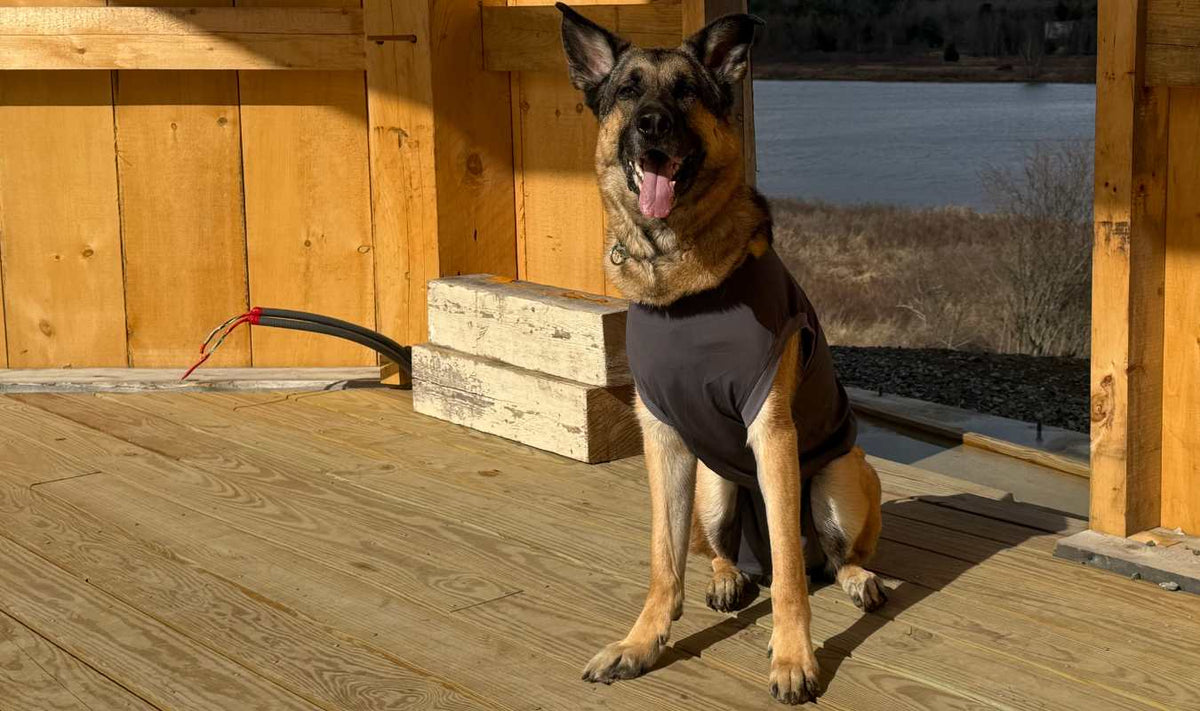
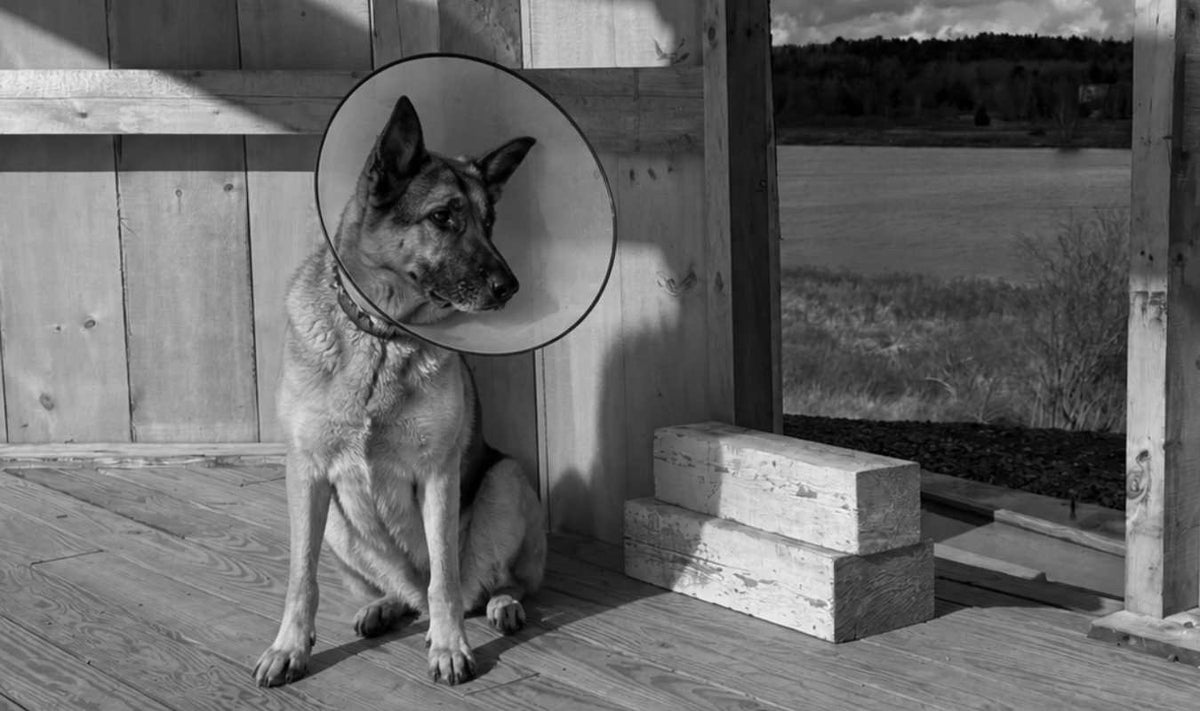
Same dog. Same deck. Two very different fortnights. Scroll, or drag the handle to compare.

This is the one advantage you have that owners arriving after surgery do not. Fit it while your dog is still comfortable and you can still exchange a size. Sizing a recovery garment on a sore dog the evening you get home from the clinic, and then discovering it is a size out, is the situation to avoid.
Owners tell us the first fitting takes a little patience and the rest are quick. Better to spend that patience on a normal Tuesday than on day one. It is two measurements and about thirty seconds.
Two measurements, thirty seconds, no guessing. Back length decides the size and chest girth confirms it.
Showing inches and pounds.

Chihuahua, Yorkshire Terrier, Toy Poodle, Maltese, Pomeranian
Shih Tzu, Bichon Frise, Jack Russell, Papillon, Miniature Dachshund
French Bulldog, Pug, Boston Terrier, Beagle, Miniature Schnauzer
Cocker Spaniel, Corgi, Border Collie, Whippet, Staffordshire Bull Terrier
Labrador, Golden Retriever, Boxer, Dalmatian, Australian Shepherd
German Shepherd, Rottweiler, Doberman, Bernese Mountain Dog, Cane Corso
Between two sizes? Go with the larger back length. Thick or fluffy coat? Allow a little extra room. No tape measure? Use a piece of string, then hold it against a ruler.
Dogs over 90 lbs:Dogs over 41 kg: our largest size fits up to a 30 in back length and a 40 in chest76 cm back length and a 102 cm chest. If your dog is bigger than that, email info@pupcovery.com before ordering and we will tell you honestly whether we can fit them.
Still not sure? Email your dog's breed, back length and chest girth to info@pupcovery.com and we will confirm the right size before your order ships.
From owners who did this already
Real reviews, unedited, and only the ones about this surgery. The last two are the critical ones, left in because they are the most useful things on this list if you are ordering for the first time.
★★★★★
Comfortable alternative to a cone
"After her spay, this suit eliminated the licking worry completely. She couldn't slip out of it no matter how much she tried, and she could move, nap and eat naturally. So much better than a disorienting Cone of Shame!"
CBear4242 Verified purchase
★★★★★
Game changer
"It actually stayed in place and kept my dog from licking stitches. Simple to take outside without fully removing the suit. My dog adjusted much faster and seemed way calmer overall."
April P. Verified purchase
★★★★★
Soft, adjustable, and easy to use
"The fabric is soft, lightweight, and breathable. The zipper and snaps feel smooth and high quality. Exactly what I needed before and after her spay."
Alex M Verified buyer
★★★★★
Much better than a cone for recovery
"A comfortable alternative to using a cone. The material is soft, breathable, and allows easy movement during recovery. I like that it's easy to take on and off for potty breaks."
Angie Verified purchase
★★★★★
Ditch the cone and let your dog rest in comfort
"If your dog has surgery coming up or is licking hot spots, this is a great suit to protect against habitual and accidental licking and wounds opening. My 75lb golden retriever fits great and seems completely comfortable wearing it all day."
SS 3x3 Verified purchase
★★★★★
Impressive quality and feel
"The soft, breathable fabric kept my dog comfortable and much less stressed compared to wearing a hard plastic collar. It fit securely without being too tight and did a good job protecting the surgery area while allowing normal movement."
Alaniss Verified purchase
★★★★★
Keeps pets comfortable while they heal
"So much better than dealing with a cone. The fabric is soft, breathable, and comfortable enough that my dog could relax and move around normally. True to size and the quality exceeded my expectations."
Jelly Morris Verified purchase
★★★★★
Works well, a little tricky to put on
"My 50lb Bernedoodle tried the suit before his neuter and I'm impressed by the quality and feel. He'll be much more comfortable in it than in a cone. The instructions are clear and it's a well-thought-out product."
Rab Verified purchase
★★★★★
Measure before ordering
"Once on, it stayed on and protected the incision exactly as advertised. The quality is solid and it's clearly well made. Just budget a little extra patience for the first fitting."
LaurenAPMT Verified purchase
Reviews are for the Pupcovery Dog Recovery Suit and are reproduced as written. Two of them tell you the first fitting takes patience and to measure before ordering, which is exactly why the section above suggests doing it before surgery day.

Fastest way to get one
Surgery dates do not move because a parcel is slow. If the operation is in the next few days, buying where you already have an account and a saved address is usually the shortest path to having it on the dog before you need it.
Buying direct is better value if you are not in a rush: order on pupcovery.com → with free shipping over $50 and the 30-day guarantee.
We are launching two supplements built for the same dogs our recovery wear is made for. Waitlist members get first access and a launch discount.

Calming chews for anxious dogs. L-theanine, L-tryptophan, chamomile and passion flower. Melatonin-free, so no drowsiness.
See the chews →
Collagen-first joint chews. UC-II at the studied dose, plus glucosamine and green-lipped mussel for hip and joint support.
See the chews →Unsubscribe any time. We never share your email.
Straight answers
Usually 10 to 14 days for a routine procedure. Sources differ slightly: the ASPCA Spay/Neuter Alliance describes a 7 to 10 day recovery period, while VCA recommends restricting activity for 7 to 14 days. Skin sutures or staples, if your dog has them rather than buried dissolvable ones, generally come out 10 to 14 days after surgery.
Not during the recovery period, which the ASPCA puts at about 10 days. The incision must not get wet, because surgical glue on the surface breaks down far too quickly once it does. Do not apply topical ointment to the site either unless your vet specifically told you to. Ask your vet before the first bath.
Bruising around the site is a normal occurrence, particularly in pale-skinned dogs. It often does not appear until a few days after the operation, and because it comes from blood seeping under the skin edges it can look much larger than the incision itself.
What matters is direction. Bumps and bruises should be shrinking and fading as the days pass. Swelling that grows, spreading redness, a foul smell or any discharge are all reasons to call the clinic.
It depends on where the incision is, and your vet is the one to ask. VCA's guidance on surgical incisions says that depending on the incision location, a surgical recovery garment covering the site may be worn as an alternative to an Elizabethan collar.
A spay incision on the abdomen or a neuter incision at the scrotum is the kind of location a body suit covers well. A wound on a leg, paw, head or ear is not, and in those cases a cone or a different barrier is the right answer. The point is to stop the licking, not to prefer one device.
Cover the site so your dog cannot physically reach it, whether that is a cone or a garment. Licking can pull sutures out and can introduce infection into the incision, which is what turns a routine fortnight into follow-up visits and extra cost. Distraction helps in the moment but is not a substitute for a barrier when you are asleep or out of the room.
No, and this is the single most common way a smooth recovery goes wrong. The painkillers have done their job and the skin looks closed, but the tissue layers underneath are not finished. Too much activity can break sutures apart or cause the incision to bleed.
Keep to leash-only toilet trips, no running, no jumping, and no getting on and off furniture, right through the restriction window your vet gave you.
This is the one thing that genuinely differs by sex. Male dogs may have a small amount of drainage or discharge for up to about three days. In females there should be no drainage, discharge or odour at all, so any of those is a reason to call.
In either case, continuous dripping, or bleeding that carries on past 24 hours, needs a vet.
Up to 30 days. A newly neutered male can still get an unspayed female pregnant during that window, which surprises most owners. In the other direction, keep a newly spayed female away from unneutered males for about a week.
Never give human medication to a dog. Some common human painkillers are dangerous and can be fatal to dogs. Your vet uses pain management before, during and after the surgery, so if your dog seems to be in pain at home, call the clinic and let them decide what to add.
Keep reading
Answers compiled from the ASPCA Spay/Neuter Alliance post-operative instructions and VCA Animal Hospitals on care of surgical incisions in dogs. General guidance only. Your vet's discharge instructions take priority.

Before the day arrives
Almost everything that goes wrong with a routine spay or neuter comes back to licking or a wet incision. Sort the first one before surgery day and the fortnight mostly takes care of itself.
Prefer Amazon? Buy the recovery suit on Amazon instead →
This page is general information about what typically happens after a routine spay or neuter, compiled from the ASPCA Spay/Neuter Alliance and VCA Animal Hospitals. It is not veterinary advice and it does not replace the discharge instructions from the clinic that operated on your dog. If you are worried about your dog's incision or recovery, call your vet.
 Dog Recovery Suit
★★★★★4.6 (28)
$32.99
›
Dog Recovery Suit
★★★★★4.6 (28)
$32.99
›
 Front Leg Sleeves
For paw and leg wounds
›
FAQ ›
Contact us ›
Front Leg Sleeves
For paw and leg wounds
›
FAQ ›
Contact us ›


