

"The fabric is soft, lightweight, and breathable. The zipper and snaps feel smooth and high quality. Exactly what I needed before and after her spay."
Alex M Verified buyer
Put something solid between your dog's mouth and the wound, so they physically cannot reach it. Whether it is an open wound or a line of stitches, telling them off and keeping an eye on them both fail the moment you blink. A cone works by stopping the head turning. A recovery suit or leg sleeve works by covering the wound itself, which most dogs tolerate far better.

This is general information, not veterinary advice. If your dog has had surgery, the discharge instructions from the clinic that operated on them always win over anything on this page. If the wound is hot, swollen, smells, or is leaking anything other than a little clear fluid, phone your vet rather than reading on.
Already know you need a suit? Get it on Amazon, often with next-day delivery for Prime members.
Rated 4.6 out of 5 from 28 Amazon reviews. Or buy direct for better value if tonight is covered.
Start here
If the licking is happening right now, work through this in order. It takes about ten minutes and it will hold until you can get a proper cover on the dog.
Look at the wound before you cover it
You need a baseline. Note the colour, whether the edges are together, and whether anything is leaking. A thin line of clear or slightly pink fluid is normal. Yellow, green, cloudy or smelly is not.
Put a barrier on now, even a temporary one
A clean t-shirt for a torso wound, pulled on backwards and knotted over the back, buys you the evening.
Move the dog somewhere boring
Not punishment, just fewer triggers. A quiet room with you in it beats a busy hallway.
Do not put anything on the wound to taste bad
Bitter sprays near a fresh surgical site are a common instinct and a bad one. They sting on broken skin and many dogs simply work through the taste.
Decide whether this is a vet call
The list further down is short and specific. If any of it matches, phone tonight rather than in the morning.
A dog can open a surgical incision in under a minute. Ten minutes of unsupervised licking can undo ten days of healing, and reopened wounds are how a routine recovery turns into a second procedure.
The reason watching fails
Licking a wound is not naughtiness and it is not anxiety in most cases. It is a hardwired grooming reflex triggered by the sensation of healing itself. As a wound closes, it releases histamine and the nerve endings around it become hypersensitive. It itches, deeply, and the dog does the only thing available to them.
This is why supervision fails. You are not competing with a habit you can interrupt, you are competing with an itch that does not stop when you are in the room. Dogs will wait. Many owners describe exactly the same pattern: the dog lies still and innocent while watched, then goes straight for the wound the moment a kettle is filled.
Then you sleep. Or you shower, or take a call, or the dog settles under the table where you cannot see them, and you find out in the morning.
What owners are told, and what is true
"A dog's mouth is clean"
It is not, and saliva carries bacteria straight into an open wound.
"Licking helps it heal"
The mechanical action of the tongue pulls healing tissue apart. It makes a wound worse, not cleaner.
"I will just keep an eye on them"
Nobody can watch a dog while they sleep, and a dog can reopen an incision in under a minute.
"They have stopped, so it is fine now"
A dog who loses interest and returns to the site on day three or four is often telling you something has changed underneath.
Expert insight
VCA Animal Hospitals is direct about this: licking an incision is one of the most common causes of surgical complications, and the popular belief that a dog's mouth is clean or that saliva helps healing is simply wrong. Their guidance is to prevent access to the site entirely rather than to manage the behaviour.
Source: VCA Animal Hospitals, Care of Surgical Incisions in Dogs
The honest comparison
The problem with the cone is not that it fails to work. It is that a cone which gets taken off at 2am protects nothing at all.
The rigid plastic cone works. That is worth saying plainly, because the rest of this section is about its costs and it would be dishonest to pretend it does not do its job. It is also the only option here that covers a head, ear or neck wound, and we would rather tell you that than sell you something that will not work.
| Option | Where it genuinely wins | Where it falls apart |
|---|---|---|
| Rigid plastic cone | Head, ear, face and neck wounds, where nothing else reaches | Eating, drinking, sleeping, stairs, doorways. Highest refusal rate of anything here |
| Recovery suit | Torso and abdominal wounds, spay and neuter sites, body hot spots | Does nothing for head, ear or neck. Needs the right size to work |
| Front leg sleeve | Wounds and hot spots from the shoulder down to the wrist | Stops above the paw. Not a solution for paw licking |
| Inflatable or donut collar | Dogs who only need stopping from reaching their own back and hips | Flexible dogs reach straight past it. Useless for lower legs |
| Soft or padded cone | A compromise for dogs who panic in rigid plastic | Folds and collapses. A determined dog gets through it |
| Supervision alone | Nothing. It is not a plan | Fails at night, in the shower, and every time you leave the room |
The best cover is not the one that works best in theory. It is the one that is still on the dog in the morning.
Want the long version, including the brands and the DIY options this table has no room for? We go through all of them in 12 best dog cone alternatives for comfortable recovery.


Two weeks is a long time to keep a dog quiet. We are launching two supplement chews, Zen Zoomies and Mighty Zoomies. Waitlist members get first access and a launch discount.
Match the cover to the wound
This is the part most advice skips, and it is the part that decides whether the thing you buy actually helps. Two of these four have no Pupcovery answer, and we would rather say so here than take the order.
Spay incisions, neuter sites, mass removals on the body, and hot spots on the flank or back. This is the clearest case for a recovery suit: it covers the whole trunk, it stays put when the dog rolls, and it unsnaps for toilet breaks without coming off.
See the Recovery Suit →Lick granulomas on the foreleg, hot spots, and wounds on the upper and lower leg above the wrist joint. A front leg recovery sleeve covers the site directly and leaves the rest of the dog free.
See the Leg Sleeves →Be straight with yourself here. No Pupcovery product covers a paw. The sleeve is measured from the top of the shoulder to the wrist joint and stops there. For genuine paw licking you need a properly fitted boot, a vet-applied dressing, or a cone. If the licking is chronic rather than injury-related, it is worth reading about acral lick dermatitis, because the underlying cause usually needs treating too.
A cone, and we would rather tell you that than sell you something that will not work. Nothing that covers the body stops a dog scratching at their own ear with a back foot. If your dog struggles badly in rigid plastic, a padded version is the compromise worth trying.

For a wound on the body
It covers a torso or abdominal wound completely, so there is nothing for the tongue to reach and nothing to argue about at 2am. It fastens along the back, unsnaps underneath for toilet breaks, and most dogs settle in it within an hour because it feels like a close t-shirt rather than a restraint.
If the surgery is in the next few days, it is also available on Amazon with faster delivery for Prime members.
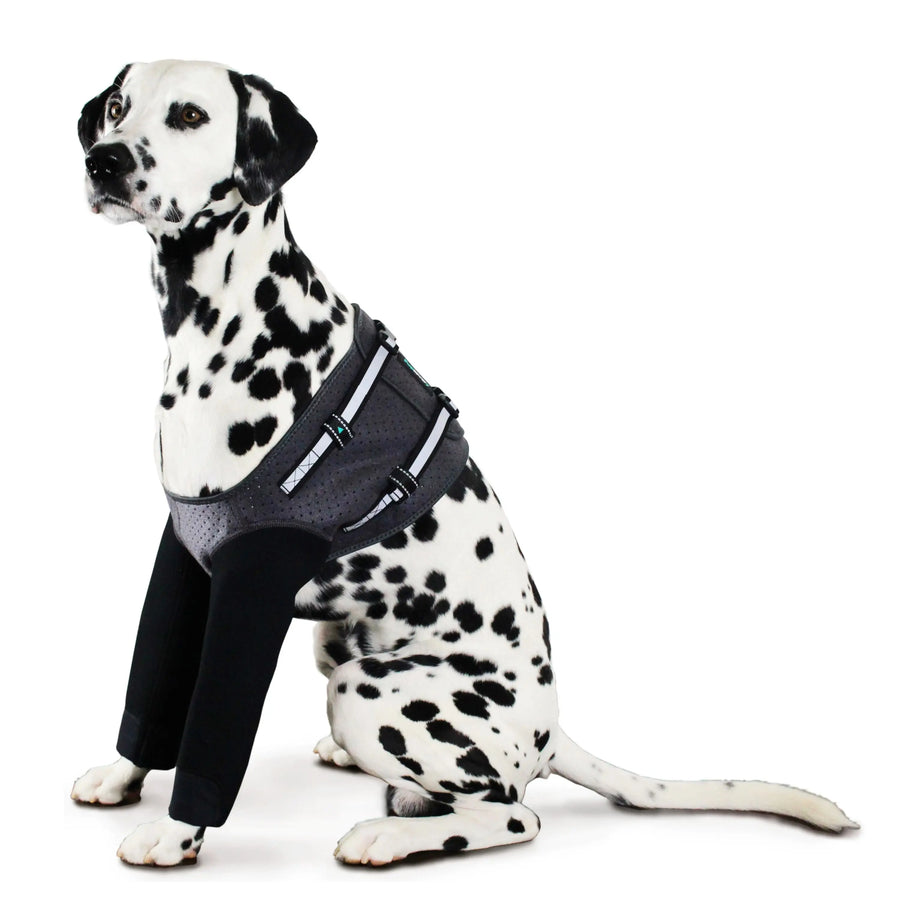
For a wound on the front leg
A suit covers the body. It does nothing for a dog working away at their own foreleg. The sleeves cover the leg itself, so the site stays clean and protected while the rest of the dog carries on as normal.
Covers
Shoulder down to the wrist joint. Lick granulomas, hot spots, stitches and wounds on the upper and lower front leg.
Does not cover
The paw, or anything below the wrist. If your dog is licking a paw, a sleeve will not reach it.
Prefer Amazon? Get the leg sleeves on Amazon → Buying direct is better value if the licking is under control tonight.
Real dogs, real owners, real recoveries
It's not all talk and no bite.
"The fabric is soft, lightweight, and breathable. The zipper and snaps feel smooth and high quality. Exactly what I needed before and after her spay."
Alex M Verified buyer

"Probably the best option I've had for my Corgi so far. A regular onesie was rubbing the insides of her front legs; this one fits true to form."
Kindle Customer Verified buyer

"I was worried about finding a suit to fit him since he's so long and oddly shaped. This one fits perfectly, goes on easy, and unsnaps for potty breaks."
Sefirothe Verified buyer
The licking worry, gone
"After her spay, this suit eliminated the licking worry completely. She couldn't slip out of it no matter how much she tried, and she could move, nap and eat naturally. So much better than a disorienting Cone of Shame!"
CBear4242 Verified purchase
It actually stayed in place
"It actually stayed in place and kept my dog from licking stitches. Simple to take outside without fully removing the suit. My dog adjusted much faster and seemed way calmer overall."
April P. Verified purchase
Habitual and accidental licking
"If your dog has surgery coming up or is licking hot spots, this is a great suit to protect against habitual and accidental licking and wounds opening. My 75lb golden retriever fits great and seems completely comfortable wearing it all day."
SS 3x3 Verified purchase
Easy on and off for potty breaks
"A comfortable alternative to using a cone. The material is soft, breathable, and allows easy movement during recovery. I like that it's easy to take on and off for potty breaks."
Angie Verified purchase
Works well, a little tricky to put on
"My 50lb Bernedoodle tried the suit before his neuter and I'm impressed by the quality and feel. He'll be much more comfortable in it than in a cone. The instructions are clear and it's a well-thought-out product."
Rab Verified purchase
Measure before ordering
"Once on, it stayed on and protected the incision exactly as advertised. The quality is solid and it's clearly well made. Just budget a little extra patience for the first fitting."
LaurenAPMT Verified purchase
Reviews are for the Pupcovery Dog Recovery Suit and are reproduced as written. The last two tell you the first fitting takes patience and to measure before ordering, which is exactly why we say the same thing above.

Fastest way to get one
A wound does not wait for a parcel. If the licking started tonight, buying where you already have an account and a saved address is usually the shortest path to having a cover on the dog before the damage is done.
Buying direct is better value if tonight is already covered: order on pupcovery.com → with free shipping over $50 and the 30-day guarantee.
If nothing can arrive tonight
You may need something before a parcel can arrive. These are worth knowing, with honest limits attached to each one.
A plain t-shirt, backwards
Front legs through the sleeves, knotted over the back. Genuinely useful for one night on a torso wound.
It rides up, it is not secure, and a determined dog gets underneath it.A baby onesie
Better than a t-shirt because the poppers hold it down, which solves the riding-up problem for a night.
Sizing is guesswork and the leg openings rub on many breeds.Men's boxer shorts, worn backwards
The large-dog version of the same trick, with the tail through the fly. Surprisingly effective for lower abdominal sites.
Surprisingly short-lived. Expect it to shift the first time they lie down properly.Self-adhesive bandage on a limb
Only if your vet has shown you how. This is the one option on this list that can do real harm.
Wrapped too tight it cuts off circulation, and that is far worse than licking.All of these are bridges, not solutions. If your dog needs covering for ten to fourteen days, none of them will last the distance.
If nothing can arrive tonight
You may need something before a parcel can arrive. These are worth knowing, with honest limits attached to each one.
A plain t-shirt, backwards
Front legs through the sleeves, knotted over the back. Genuinely useful for one night on a torso wound.
It rides up, it is not secure, and a determined dog gets underneath it.A baby onesie
Better than a t-shirt because the poppers hold it down, which solves the riding-up problem for a night.
Sizing is guesswork and the leg openings rub on many breeds.Men's boxer shorts, worn backwards
The large-dog version of the same trick, with the tail through the fly. Surprisingly effective for lower abdominal sites.
Surprisingly short-lived. Expect it to shift the first time they lie down properly.Self-adhesive bandage on a limb
Only if your vet has shown you how. This is the one option on this list that can do real harm.
Wrapped too tight it cuts off circulation, and that is far worse than licking.All of these are bridges, not solutions. If your dog needs covering for ten to fourteen days, none of them will last the distance.
When covering is not enough
Covering the wound is the right move in most cases. These are the cases where it is not enough on its own.
Phone your vet if you see any of these
That last one is worth taking seriously. A dog who loses interest and then returns to the site on day three or four is often telling you something has changed underneath. For a proper picture of what normal and abnormal look like at each stage, read dog stitches healing stages, and for cleaning and dressing technique see dog wound care at home.
Expert insight
The ASPCA Spay/Neuter Alliance advises keeping the surgical site dry and protected for the full recovery period, and treating any separation of the incision edges as a reason to contact the clinic rather than something to monitor at home. Their discharge guidance also stresses restricting activity, because movement and licking together are what reopen a closing wound.
Source: ASPCA Spay/Neuter Alliance, After Surgery Instructions
Most refusals are fixable
Most refusals are introduction problems, not product problems.
Fit it before you need it
If surgery is booked, put the suit on for twenty minutes a few days beforehand, with a meal. A dog who has worn it once already does not associate it with waking up sore.
Measure rather than guess the size
The single most common complaint in the reviews is people ordering by eye. One reviewer titled hers simply "measure before ordering", and she is right.
Expect five minutes of theatre
Many dogs freeze or walk strangely at first. Feed them, take them outside, and it usually passes within the hour.
Check underneath twice a day
Any cover can rub. Look at the armpits and the edges, and make sure the wound itself is still dry.
We are launching two supplements built for the same dogs our recovery wear is made for. Waitlist members get first access and a launch discount.

Calming chews for anxious dogs. L-theanine, L-tryptophan, chamomile and passion flower. Melatonin-free, so no drowsiness.
See the chews →
Collagen-first joint chews. UC-II at the studied dose, plus glucosamine and green-lipped mussel for hip and joint support.
See the chews →No spam. Unsubscribe in one click.
Questions owners ask
How do I stop my dog licking a wound at night?
Cover it, because night is when supervision is guaranteed to fail. A recovery suit for a torso wound or a sleeve for a foreleg can stay on while the dog sleeps. If you have nothing yet, a t-shirt worn backwards and knotted over the back will get you to morning.
Can I let my dog go without a cone if I watch them closely?
Not safely. You cannot watch a dog while you sleep, and a dog can reopen an incision in under a minute. Going cone-free is realistic, but only if something else is covering the wound.
Does dog saliva help a wound heal?
No. This is one of the most persistent myths in dog care. Saliva carries bacteria into the wound and the mechanical action of the tongue pulls healing tissue apart. Licking makes a wound worse, not cleaner.
Why is my dog suddenly licking more on day three or four?
Often because healing itself itches as the wound closes. But a sudden return of interest after a quiet spell can also mean infection or a stitch reaction, so look at the site properly rather than assuming it is just the itch.
Will a recovery suit stop my dog licking a paw?
No, and neither will our leg sleeves. The sleeve covers from the shoulder down to the wrist joint and stops above the paw. For paw licking you need a fitted boot, a vet-applied dressing, or a cone.
Is a t-shirt enough to stop a dog licking stitches?
For one night, often yes. For ten to fourteen days, no. T-shirts ride up, twist, and leave gaps at the belly, which is exactly where most surgical incisions are.
Should I put bitter spray on the wound to stop the licking?
Not on or near a fresh surgical site. Most of these sprays are alcohol based and sting on broken skin, and plenty of dogs simply tolerate the taste. Covering the wound removes the access instead of relying on deterrence.
How long does my dog need to be stopped from licking?
Usually ten to fourteen days for a surgical wound, and until your vet confirms healing for anything else. The temptation is to relax around day seven when it looks fine, and that is precisely when reopened wounds happen.
Is a recovery suit safe to leave on overnight?
Yes, that is what it is designed for, and overnight is when it matters most. Check underneath twice a day for rubbing at the armpits and edges, and make sure the wound stays dry.
Do inflatable and donut collars actually work?
For some dogs and some locations, genuinely yes. They are good at stopping a dog reaching their own back and hips, and far more comfortable than rigid plastic. Flexible dogs reach straight past them, and they do nothing for a lower leg.
My dog is recovering from a spay. What is the best option?
A recovery suit, because a spay incision is on the abdomen and a suit covers the whole area while leaving the head free. We walk through the full fortnight in our dog spay and neuter recovery guide.
Can my dog go to the toilet normally while wearing a recovery suit?
Yes. The underside unsnaps so you can fold it back for toilet breaks without taking the whole suit off, which is the difference between a cover that stays on and one that gets left off after the second trip outside.
One last thing
Not buying anything today? Take the list instead.
We are launching two supplement chews. Waitlist members get first access and a launch discount, and one email when they land rather than a drip.

Before you go back to watching them
Almost everything that goes wrong with a healing wound comes back to licking. Take the access away and the rest of the fortnight mostly takes care of itself.
Need it faster? Buy the recovery suit on Amazon instead →
This page is general information about stopping a dog licking a healing wound, compiled from the VCA Animal Hospitals guidance on surgical incisions and the ASPCA Spay/Neuter Alliance after-surgery instructions. It is not veterinary advice and it does not replace the discharge instructions from the clinic that treated your dog. If you are worried about your dog's wound, call your vet.
 Dog Recovery Suit
★★★★★4.6 (28)
$32.99
›
Dog Recovery Suit
★★★★★4.6 (28)
$32.99
›
 Front Leg Sleeves
For paw and leg wounds
›
FAQ ›
Contact us ›
Front Leg Sleeves
For paw and leg wounds
›
FAQ ›
Contact us ›
