
Dog After Surgery Care at Home: A Complete First-Week Checklist
The car ride home is quiet. Your dog is groggy, faintly perfumed with antiseptic, and looking at you as if you personally authorised the whole ordeal. Somewhere in your bag is a discharge sheet you have already read four times, and you still feel like you are missing something. Good dog after surgery care at home is simpler than the anxiety suggests: keep your dog calm and confined, protect the incision from licking, give the prescribed medications exactly as directed, watch the wound daily, and know the handful of warning signs that mean you pick up the phone.
This guide walks you through the whole first week and beyond, from the wobbly first night to the day the stitches finally come out. You will get realistic timelines, honest cost expectations, a clear cone-versus-suit comparison, and a triage list that tells you exactly when normal healing has tipped into something that needs a vet.
The discharge sheet makes it all sound simple. Then you get home and realize the discharge sheet has never met your dog.
Quick Answer
Dog after surgery care at home means six things: strict rest and confinement, stopping licking with a cone or recovery suit, giving all prescribed medications (never human painkillers), checking the incision once or twice daily, keeping the wound dry, and calling your vet for opening wounds, pus, heavy bleeding, repeated vomiting, or uncontrolled pain. Routine surgeries need roughly 10 to 14 days of restriction; orthopaedic repairs need weeks to months.
Key Takeaways
- Activity restriction is the single most important step; too much movement too soon can open the incision.
- Keep a cone or recovery suit on at all times until your vet confirms the wound has healed, usually 10 to 14 days for routine surgery.
- Never give human painkillers such as ibuprofen, aspirin or paracetamol; the ASPCA lists these as toxic to dogs.
- Mild redness and slight swelling can be normal early; spreading redness, pus, a foul smell, or a gaping wound are not.
- Feed a small light meal the first night, then return to normal food if there is no vomiting.
- Orthopaedic surgeries such as cruciate repair follow a much longer, staged recovery than a spay or neuter.
In This Article
- The first 24 to 48 hours after anaesthesia
- Activity restriction and confinement
- Protecting the incision: cones vs suits
- Wound care and daily monitoring
- When your dog won't stop licking the wound
- Pain management and medications
- Feeding, hydration and toileting
- When to contact your vet urgently
- Common owner mistakes
- Procedure-specific recovery timelines
- How much does post-op care cost
- Frequently asked questions
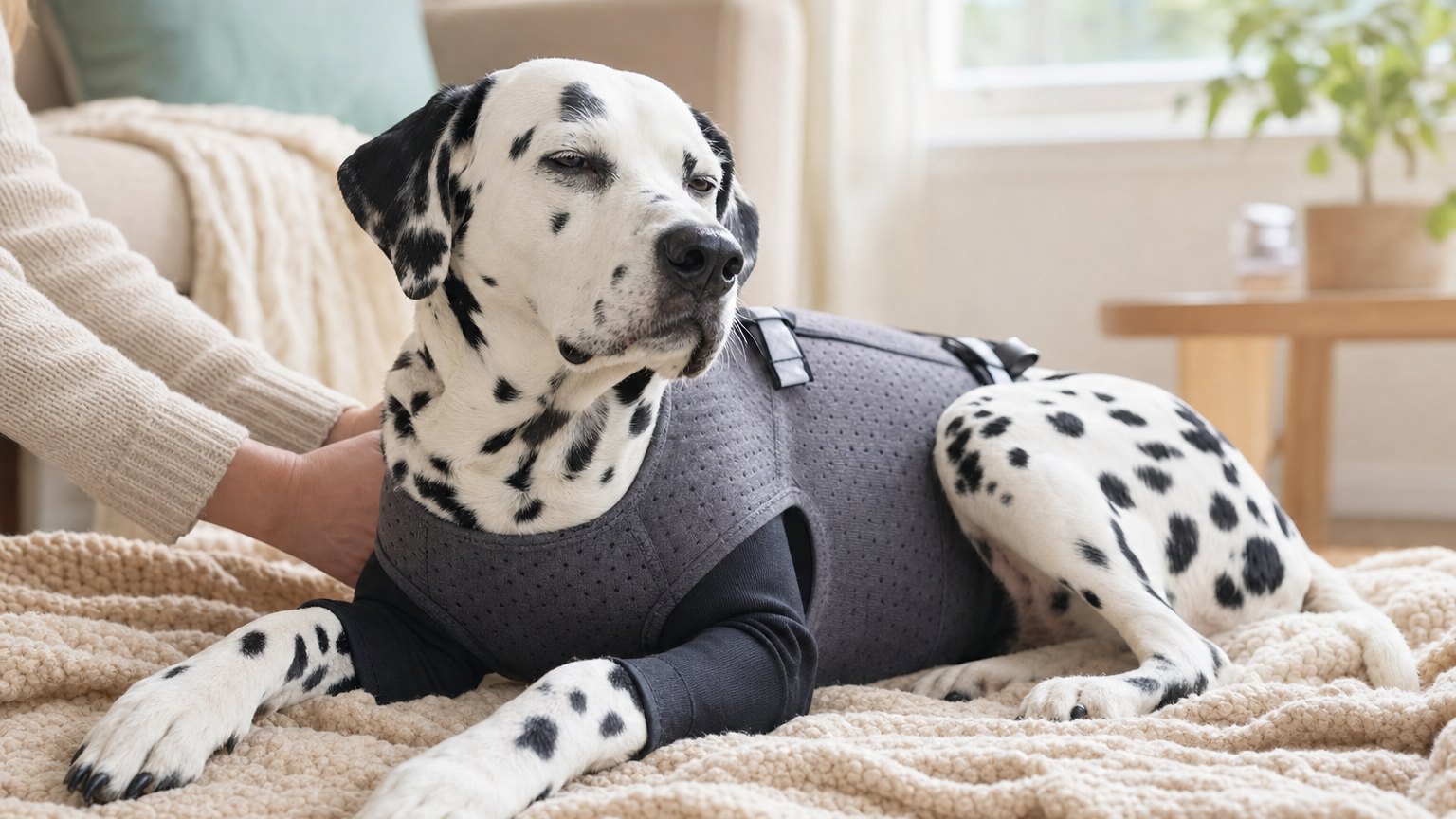
What should I expect in the first 24 to 48 hours after anaesthesia?
Expect a sleepy, unsteady, slightly baffled dog for the first 12 to 24 hours as the anaesthetic wears off. The American Kennel Club notes that grogginess, wobbliness and quietness are normal after a general anaesthetic, and this is not the moment for enthusiasm of any kind. Your job on night one is mostly to be a good bouncer: no stairs, no sofa leaps, no visitors treating your dog like a returning war hero.
Day one usually goes better than owners fear. The dog sleeps, you hover, and very little happens. It is day four, when the anaesthetic haze has fully lifted and the incision has become the most fascinating object your dog has ever encountered, that the real test of your patience begins.
Keep the recovery space warm, quiet and draught-free. Anaesthesia interferes with temperature regulation, so a dog that seeks out a warm corner is behaving exactly as expected, according to VCA Animal Hospitals. A soft bed on the floor beats anything raised, because getting on and off furniture is precisely the movement you are trying to prevent.
You are probably going to check on your dog roughly every twenty minutes for the first evening, torch in hand, second-guessing every twitch. That is normal owner behaviour, not overreaction. The distinction that matters is between lingering grogginess, which improves hour by hour, and deterioration, which does not.
Expert Insight: The American Kennel Club advises that most dogs are fully alert within 24 to 48 hours after anaesthesia; a dog that remains extremely lethargic, cannot stand, or seems to be getting worse rather than better after the first day should be seen promptly.
Source: American Kennel Club (AKC)
Food and water on the first night
Offer a small, light meal on the evening of surgery, roughly half the normal amount, because anaesthesia commonly causes nausea and a full bowl invites vomiting. The ASPCA recommends a quiet return to normal feeding the next day if there is no vomiting. Water should generally be available unless your discharge notes say otherwise.
If your dog turns their nose up at dinner the first night, do not panic and do not start cooking a three-course tasting menu to tempt it. A subdued appetite for a day after anaesthesia is ordinary. Don't panic and don't start cooking a three-course tasting menu to tempt them. The clock only starts to matter if the refusal stretches past 24 to 48 hours.
Why is activity restriction the most important step?
Veterinary sources are unanimous: activity restriction matters most. Too much movement too soon pulls incisions open — a complication called dehiscence — and can wreck an orthopaedic repair. The American College of Veterinary Surgeons stresses that controlled activity is central to uncomplicated healing after surgery.
The recovery plan always looks excellent on paper. Nobody shows it to the Labrador. Within days most dogs feel dramatically better than they look to you, which is exactly the trap: a dog that feels good wants to run, and a running dog undoes a week of careful healing in three seconds flat.
Keep your dog on a short lead for necessary toilet breaks and confined the rest of the time. A crate, a pen, or a small room with the doors shut all work; the goal is simply to remove the option of jumping, sprinting, and stair-climbing. For high-energy dogs this feels cruel for about a day, until they settle into the enforced holiday.
The duration depends heavily on the procedure. Routine spay and neuter surgeries usually need around 10 to 14 days of restriction, according to the ASPCA. Orthopaedic surgeries need far longer and far stricter confinement, often measured in weeks to months, with activity reintroduced in stages only on the surgeon's instruction. Our complete dog spay recovery guide covers the routine timeline in more depth.

Day one: your dog is groggy and cooperative. Day four: your dog feels absolutely fine and has a list of grievances about the cone situation.
Cone vs recovery suit: how do I protect the incision?
Protecting the incision means putting a physical barrier between your dog's tongue and the wound, because licking and chewing introduce bacteria, loosen sutures, and can open the incision entirely. VCA Animal Hospitals advises keeping a barrier on at all times, including overnight and whenever the dog is unsupervised, until healing is complete.
What makes licking so maddening is that the behaviour creates the very problem the dog is trying to soothe. A dog licks because the wound feels odd, the licking irritates the skin, the skin feels worse, and the dog licks more. Breaking that loop is the entire point of a cone or a suit.
There is no single right barrier for every dog, so here is an honest comparison of the realistic options before we point you at ours.
| Option | Best for | Trade-offs | Verdict |
|---|---|---|---|
| Hard plastic cone (Elizabethan collar) | Reaching wounds on legs, paws, tail and head | Bumps doorframes, disrupts eating and sleep, stresses many dogs | Effective and cheap; often poorly tolerated |
| Inflatable or soft padded collar | Dogs that panic in a hard cone; body wounds out of reach | Some dogs still reach paws and flanks; less rigid | Comfortable but not universal |
| Recovery suit / bodysuit | Abdominal, chest, flank and back incisions such as spays | Not ideal for lower-leg or head wounds; needs correct sizing | Comfortable full-torso cover; best for body incisions |

Expert Insight: VCA Animal Hospitals notes that the biggest risk with any protective device is removing it too early; owners often take the cone off once the dog seems fine, which is exactly when a curious dog reaches the healing incision.
Source: VCA Animal Hospitals
For abdominal surgery in particular, a recovery suit often wins on comfort because it covers the wound with breathable fabric instead of trapping the dog inside a plastic funnel. Our roundup of the best dog cone alternatives for 2026 compares the full range if you want to weigh every device side by side.
How do I care for and monitor the wound each day?
Inspect the incision at least once or twice a day, and learn what your dog's normal healing looks like so you can spot when it changes. Cornell University's Riney Canine Health Center advises regular incision checks as a core part of home aftercare, because early infection is far easier to treat than late infection.
Some things are genuinely normal in the first few days: mild redness at the wound edges, slight swelling, and occasionally a little bruising. A thin line of pinkness is not an emergency. It is the trend that tells the story, and a wound that looks a bit better each day is a wound that is healing.
You are probably examining the incision ten times a day and photographing it for scale, which is completely understandable. To keep yourself sane, take one clear photo each morning in the same light so you can compare like with like rather than relying on anxious memory. Our guide to dog stitches healing stages shows what each phase should look like.
Expert Insight: Cornell University College of Veterinary Medicine advises keeping the incision clean and dry and avoiding any creams, ointments or antiseptics unless your veterinarian specifically prescribes them, because many topical products delay healing or provoke licking.
Source: Cornell University Riney Canine Health Center

Keeping the wound clean and dry
Do not bathe your dog, let them swim, or apply any product to the incision unless your vet tells you to. VCA Animal Hospitals advises keeping the site dry, since water softens the wound and can carry bacteria in. Most clinics ask you to skip baths for roughly 10 to 14 days, typically until the sutures come out.
If the incision gets muddy on a toilet trip, resist the urge to scrub it. A damp cloth around the area, kept away from the wound itself, is usually enough, and anything more should be checked with your clinic first.
When your dog won't stop licking the wound
The problem: your dog has discovered the incision and treats it as a newly acquired hobby, licking and nibbling at stitches the moment your back is turned, risking infection and a reopened wound.
The solution: A purpose-designed recovery suit that covers the wound with soft, breathable fabric so your dog physically cannot reach it, without the panic and clatter of a traditional cone.

Also on Amazon for fast delivery. For dogs that reach stitches despite every barrier, our guide on how to keep a dog from licking stitches without a cone covers the extra tactics that help.
How should I manage pain and medications?
Give every prescribed medication exactly as directed, and never substitute a human painkiller. Your discharge notes may include a veterinary anti-inflammatory for pain and, in some cases, antibiotics, and the golden rule with antibiotics is to finish the entire course even after your dog looks completely recovered.
This is the safety point that matters most in the whole article, so it gets no jokes. The ASPCA Animal Poison Control lists common human painkillers, including ibuprofen, naproxen, aspirin and paracetamol (acetaminophen), as toxic to dogs, capable of causing serious and sometimes fatal harm. Only give pain relief that your own veterinarian has prescribed or specifically approved.
Knowing whether pain is controlled is a genuine worry, because your dog cannot tell you. The Merck Veterinary Manual describes signs of inadequate pain relief including persistent whining, restlessness, reluctance to move, panting, guarding the surgical site, and an inability to settle. If those persist despite the prescribed dose, call the clinic rather than reaching for anything in your own cabinet.
Expert Insight: The Merck Veterinary Manual notes that modern canine pain relief works best when given proactively on schedule rather than waiting for obvious distress, so keep to the exact timing on the label rather than skipping doses because your dog seems comfortable.
Source: Merck Veterinary Manual

What about feeding, hydration and toileting during recovery?
Assuming no vomiting, most dogs return to their usual food the day after surgery. A slightly reduced appetite for the first day is normal after anaesthesia, but an appetite that has not returned within 24 to 48 hours should be reported to your vet, as the ASPCA advises.
Fresh water should always be available. If your dog is eating but not drinking, or seems reluctant at the bowl, our guide on a dog not drinking water but eating explains what is normal and when to worry.
Bowel movements often lag for a day or two, thanks to pre-surgery fasting and the slowing effect of anaesthesia on the gut. A dog that has not passed a stool for a couple of days but is comfortable, eating and not straining is usually fine. Straining, obvious discomfort, or ongoing constipation is worth a call.
Toilet trips become a small daily negotiation, especially for a dog wearing a cone or suit and forbidden from its usual sniffing patrol. Keep them lead-only, keep them short, and expect your dog to look mildly betrayed by the new brevity of outdoor life.

When should I contact my vet urgently?
Call your clinic, or an emergency service after hours, the moment normal healing tips into something that looks wrong. The list below is your triage frame: mild, improving signs can be watched at home, but any of the following warrant a phone call rather than a wait-and-see.
When to Call Your Vet
- The incision opens, gapes, bleeds heavily, or leaks pus or foul-smelling discharge
- Redness, swelling or heat around the wound is spreading or worsening rather than fading
- Repeated vomiting or diarrhoea
- No eating or drinking beyond 24 to 48 hours
- Lethargy, collapse or weakness that continues past the expected first-day grogginess
- Pale gums, laboured breathing, or a swollen, painful abdomen
- Pain that is not controlled by the prescribed medication
A wound that smells is one of the clearest early signals that something has gone wrong, and it is worth acting on quickly. Our guide on what a foul-smelling dog wound actually means walks through the likely causes and next steps.
Trust the discharge paperwork over any general list, including this one. The surgeon who operated on your dog knows the procedure-specific red flags, and those instructions always take priority over generic advice.
If you have removed the cone "just for a minute" while watching carefully, you have removed the cone for an indeterminate amount of time while distracted. This is every owner. Every single one.
What are the most common owner mistakes?
The most common mistakes in home care after dog surgery all share a theme: they happen when the dog looks recovered before the wound actually is. A dog can feel wonderful and heal terribly at the same time, and that gap is where trouble lives.
- Removing the cone or suit too soon because the dog seems fine, giving the tongue a window to reopen the wound.
- Allowing jumping, stairs and play before the restriction period ends, risking dehiscence or orthopaedic damage.
- Bathing the dog or letting them swim with an unhealed incision.
- Giving human painkillers, which the ASPCA lists as toxic to dogs.
- Stopping antibiotics early once the dog looks better instead of finishing the course.
- Overfeeding on the first night, which worsens anaesthesia-related nausea.
- Not checking the incision daily, so an infection is caught late instead of early.
- Skipping the suture-removal or recheck appointment because everything seems healed.
If you recognise yourself in more than one of these, welcome to the club; almost every owner is tempted by at least a couple. The suit-removal one in particular catches nearly everyone around day five, when the dog is bright, bouncy and utterly convinced the whole thing is behind it.
Day one: your dog slept through it all. You, however, checked on them twelve times and spent forty minutes reading about "normal post-op breathing." Both responses are valid. Only one of you will remember this week fondly.
How long does it take a dog to recover from surgery?
Recovery time depends almost entirely on the type of surgery. Routine soft-tissue procedures follow a short, predictable course, while orthopaedic repairs demand a long, staged rehabilitation that you should never speed up on your own judgement.
| Surgery type | Typical restricted period | Suture removal | Notes |
|---|---|---|---|
| Spay or neuter | About 10 to 14 days | Around 10 to 14 days, or dissolving sutures | Abdominal spay incision needs strict rest |
| Lump or mass removal | About 10 to 14 days | Around 10 to 14 days | Depends on size and location |
| Cruciate / ACL repair (e.g. TPLO) | Roughly 8 to 12 weeks, staged | Around 10 to 14 days for skin | Structured, vet-guided rehab |
| Fracture repair | Weeks to months | Varies | Follow surgeon's phased plan |
| Dental extractions | Days to about 2 weeks | Often dissolving sutures | Soft food during healing |
Expert Insight: The American College of Veterinary Surgeons emphasises that orthopaedic recovery such as cruciate ligament repair follows a phased return to activity guided by the surgeon, and that owners who free-exercise a dog too early risk implant failure and repeat surgery.
Source: American College of Veterinary Surgeons (ACVS)
Skin sutures or staples usually come out about 10 to 14 days after surgery, according to the ASPCA. Some incisions are closed with absorbable (dissolving) sutures beneath the skin that never need removing; your discharge notes will tell you which type your dog has. For orthopaedic timelines, our week-by-week guides to TPLO surgery recovery and dog ACL surgery recovery go far deeper.
Keeping the wound protected through the whole first week
The problem: the middle of the first week is when most dogs stop tolerating the cone, start reaching the wound at night, and generally treat every protective measure as a challenge to be defeated.
The solution: A comfortable, full-torso recovery suit your dog will actually keep on, so incision protection lasts the entire healing period rather than collapsing on day four.
If the suit itself causes any rubbing, our guide on recovery suit skin irritation explains how to fix the fit.
How much does post-op care cost?
Post-op care costs vary widely by region, clinic, and procedure, so any single figure would be misleading. The predictable expenses are recovery collars or suits, prescribed pain relief and antibiotics, and the follow-up recheck or suture-removal visit, which many clinics include in the original surgical fee.
A reliable current price for these items could not be verified for this guide, so treat cost as something to confirm directly with your own clinic when you book, rather than a number to guess at. Ask up front what the quote covers, because whether medications and rechecks are bundled in makes a real difference to the total.
The one cost worth avoiding entirely is the second surgery. Skimping on incision protection or rushing activity restriction is the classic false economy, since a reopened wound or a failed orthopaedic repair costs far more than a suit and a fortnight of patience.
Give the Incision the Best Chance to Heal
A comfortable recovery suit protects the wound around the clock, so the first week goes to plan and your dog gets back to being your dog.
Shop the Recovery Suit →Frequently Asked Questions: Dog After Surgery Care at Home

How long does a dog need to rest after surgery?
For routine soft-tissue surgery such as spay or neuter, most clinics advise about 10 to 14 days of restricted activity, according to the ASPCA. Orthopaedic surgeries such as cruciate repair usually require far longer, often 8 to 12 weeks of staged restriction guided by the surgeon.
Can my dog sleep in my bed after surgery?
Generally no during the restricted period, because climbing on and off the bed involves jumping that can strain or open the incision. Set up a low, comfortable bed on the floor in a confined space instead, and reintroduce furniture only once your vet confirms healing is complete.
When can my dog go up and down stairs again?
Stairs are usually discouraged during the initial restriction period and reintroduced only when your vet advises. After orthopaedic surgery this can be several weeks, and the return to stairs is part of the phased rehabilitation plan the American College of Veterinary Surgeons describes.
Do I really need the cone? My dog hates it.
Some barrier is essential, but it does not have to be a hard cone. VCA Animal Hospitals stresses keeping the incision protected until it heals, so a recovery suit or soft collar approved by your vet is a valid alternative for body wounds. The device matters less than keeping the tongue off the incision.
Can I give my dog ibuprofen or paracetamol for pain?
No. The ASPCA lists ibuprofen, aspirin, naproxen and paracetamol (acetaminophen) as toxic to dogs, capable of causing serious or fatal harm. Only give pain relief that your own veterinarian has prescribed, and call the clinic if the prescribed dose does not seem to control the pain.
Is some swelling and redness normal after surgery?
Mild redness at the wound edges and slight swelling can be normal in the first few days. The concern is the trend: spreading redness, increasing swelling, heat, discharge, or a gaping wound are warning signs that Cornell University advises reporting to your vet promptly.
When can I bathe my dog after surgery?
Usually not until the incision has healed and sutures are removed, commonly around 10 to 14 days. VCA Animal Hospitals advises keeping the wound dry and avoiding baths and swimming until your vet clears it, since water softens the incision and can carry in bacteria.
My dog won't eat the night of surgery. Is that OK?
Yes, a reduced appetite on the first evening is common because anaesthesia causes nausea. Offer a small light meal and try again the next day. If your dog still is not eating after 24 to 48 hours, contact your vet, as the ASPCA advises reporting a persistent lack of appetite.
How do I know if the incision is infected?
Signs of infection include increasing redness and swelling, warmth at the site, pus or foul-smelling discharge, and pain. Cornell University advises daily incision checks so these changes are caught early. If you notice any of them, call your clinic rather than waiting.
When are stitches removed?
Skin sutures or staples are typically removed about 10 to 14 days after surgery, according to the ASPCA. Some incisions use absorbable sutures beneath the skin that dissolve on their own and never need removal. Your discharge notes will specify which type your dog has.
Why is my dog not pooping after surgery?
Delayed bowel movements for a day or two are common after surgery, caused by pre-op fasting and the slowing effect of anaesthesia on the gut. A comfortable dog that is eating and not straining is usually fine. Straining, discomfort or ongoing constipation is worth a call to your vet.
How much does post-op care cost?
Costs vary widely by region, clinic and procedure, covering recovery collars or suits, medications and follow-up visits. A reliable current figure could not be verified for this guide, so confirm the total directly with your clinic and ask whether medications and rechecks are included in the surgical fee.

Sources and References
- ASPCA. Spay/Neuter Your Pet and Animal Poison Control. aspca.org.
- VCA Animal Hospitals. Surgery Postoperative Care in Dogs. vcahospitals.com.
- American Kennel Club. Dog Surgery Recovery and Anaesthesia. akc.org.
- American College of Veterinary Surgeons. Postoperative Care. acvs.org.
- Cornell University Riney Canine Health Center. Surgical Aftercare. vet.cornell.edu.
- Merck Veterinary Manual. Pain Assessment and Management in Animals. merckvetmanual.com.


